ClarityOne Publishing

All books

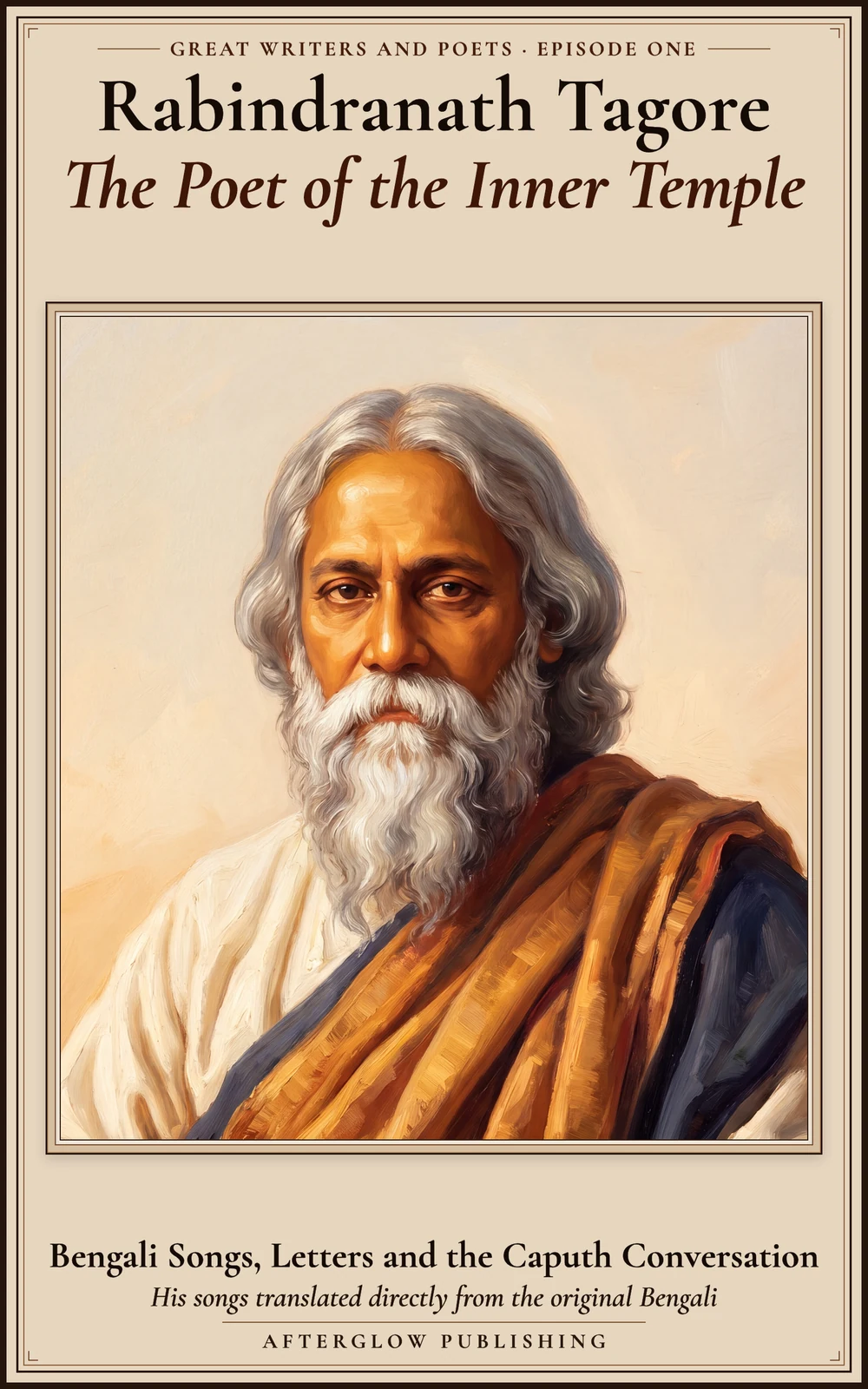
Rabindranath Tagore: The Poet of the Inner Temple — Bengali Songs, Letters and the Caputh Conversation

Great Writers and Poets

Rabindranath Tagore: The Poet of the Inner Temple

A river, a song, an afternoon with Einstein. Meet Tagore through his own words.

Made by ClarityOne Publishing.

Inside the pocket edition

Look inside.

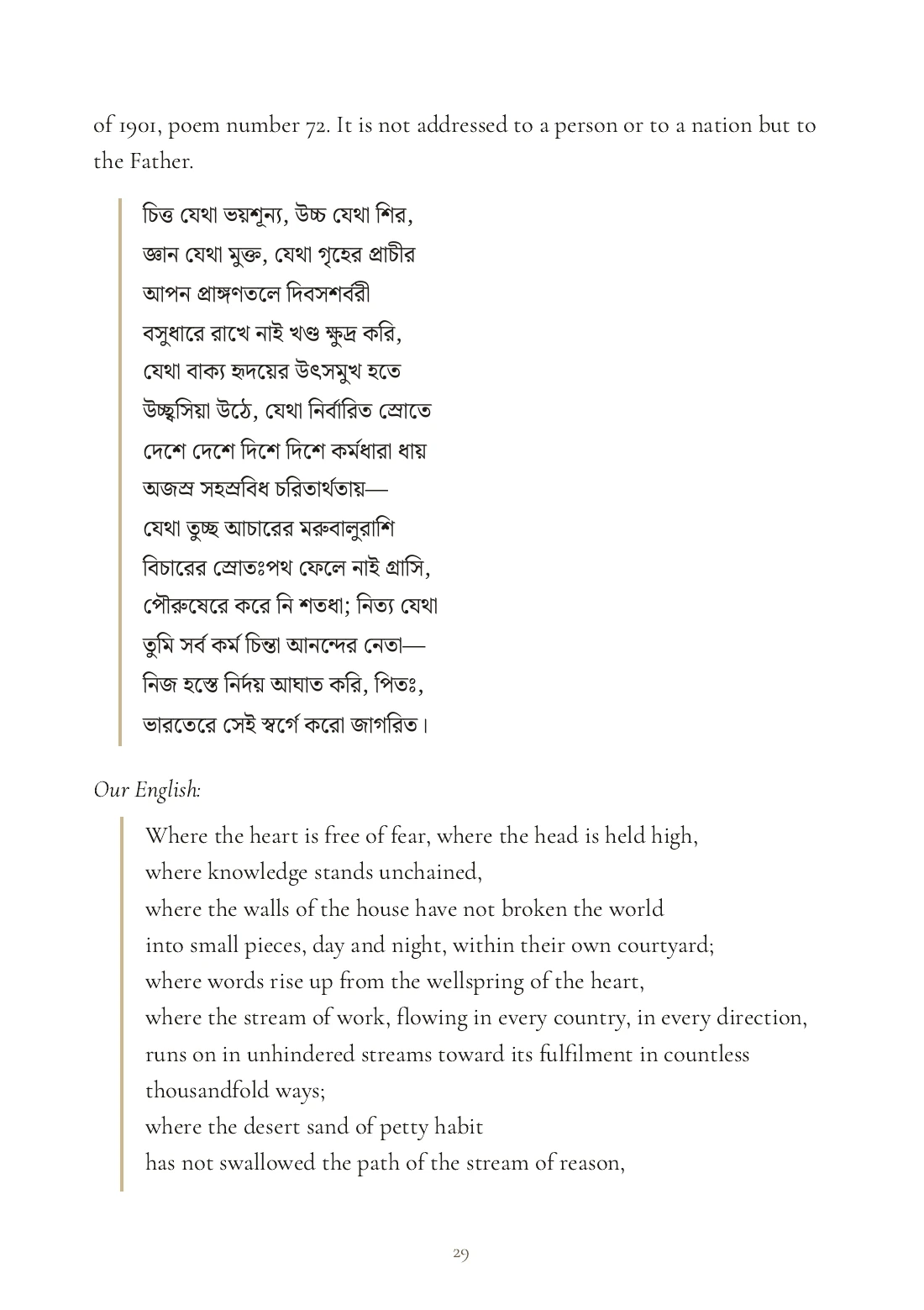
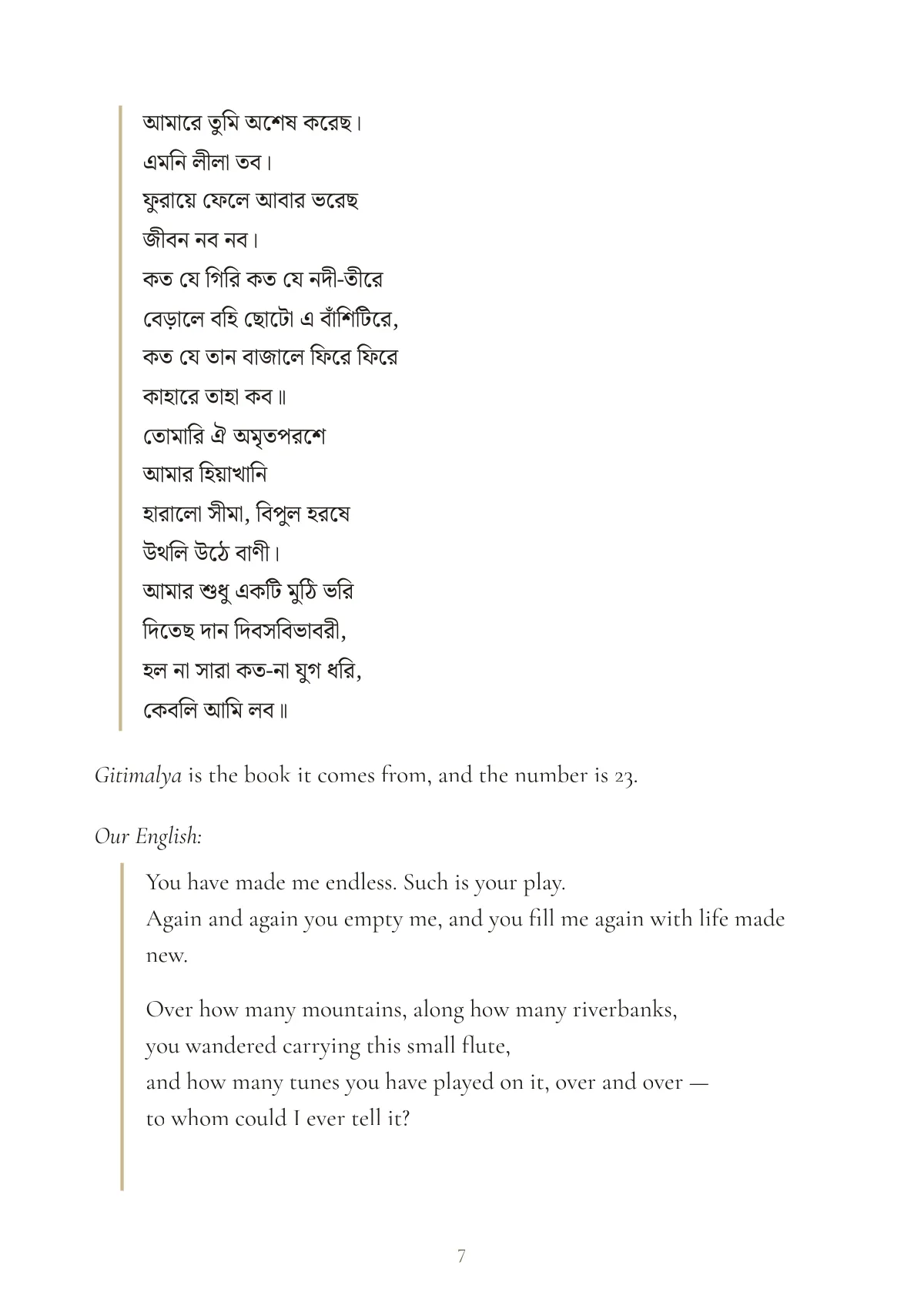
A page from the English edition: Bengali source text with our English translation.
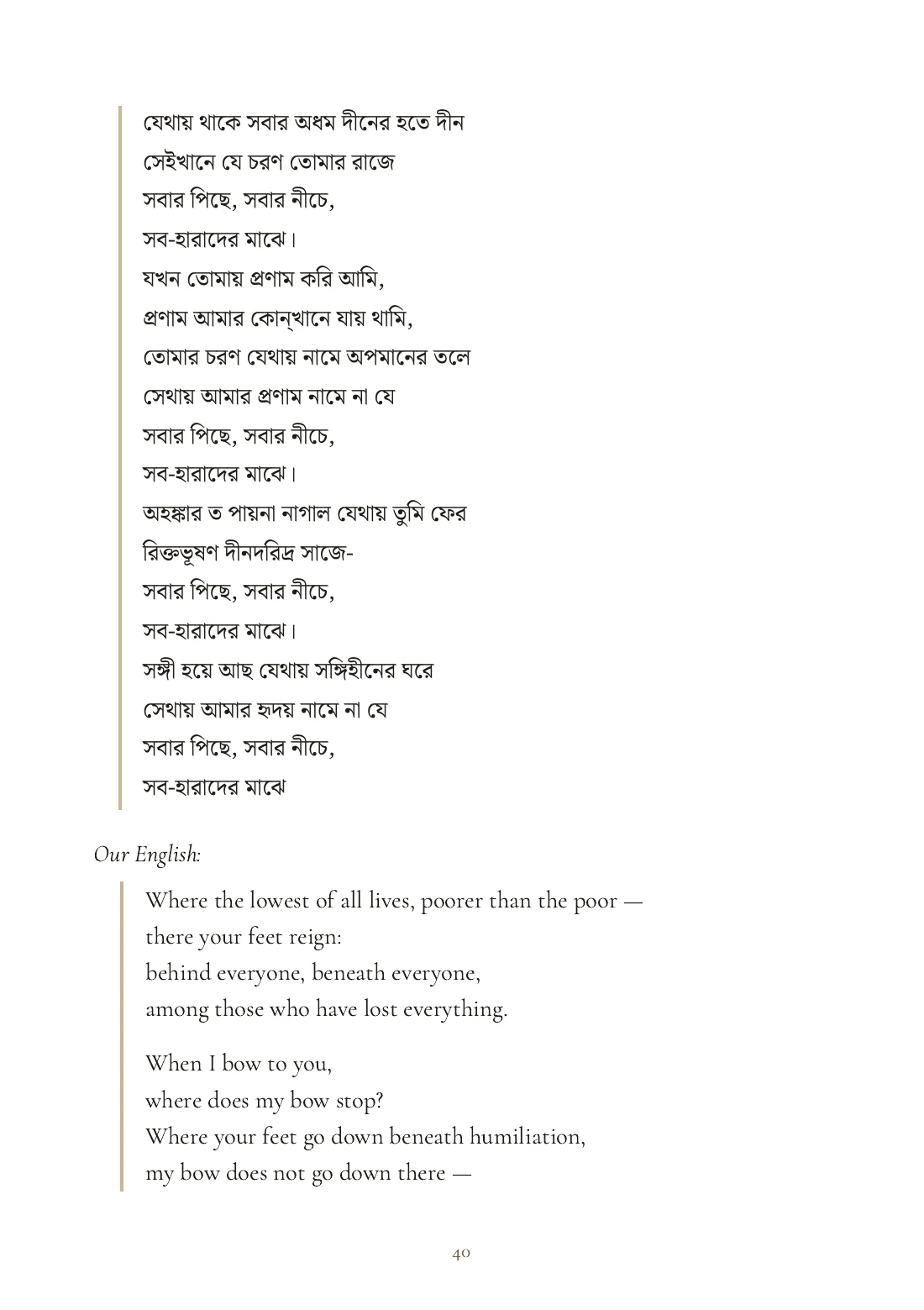
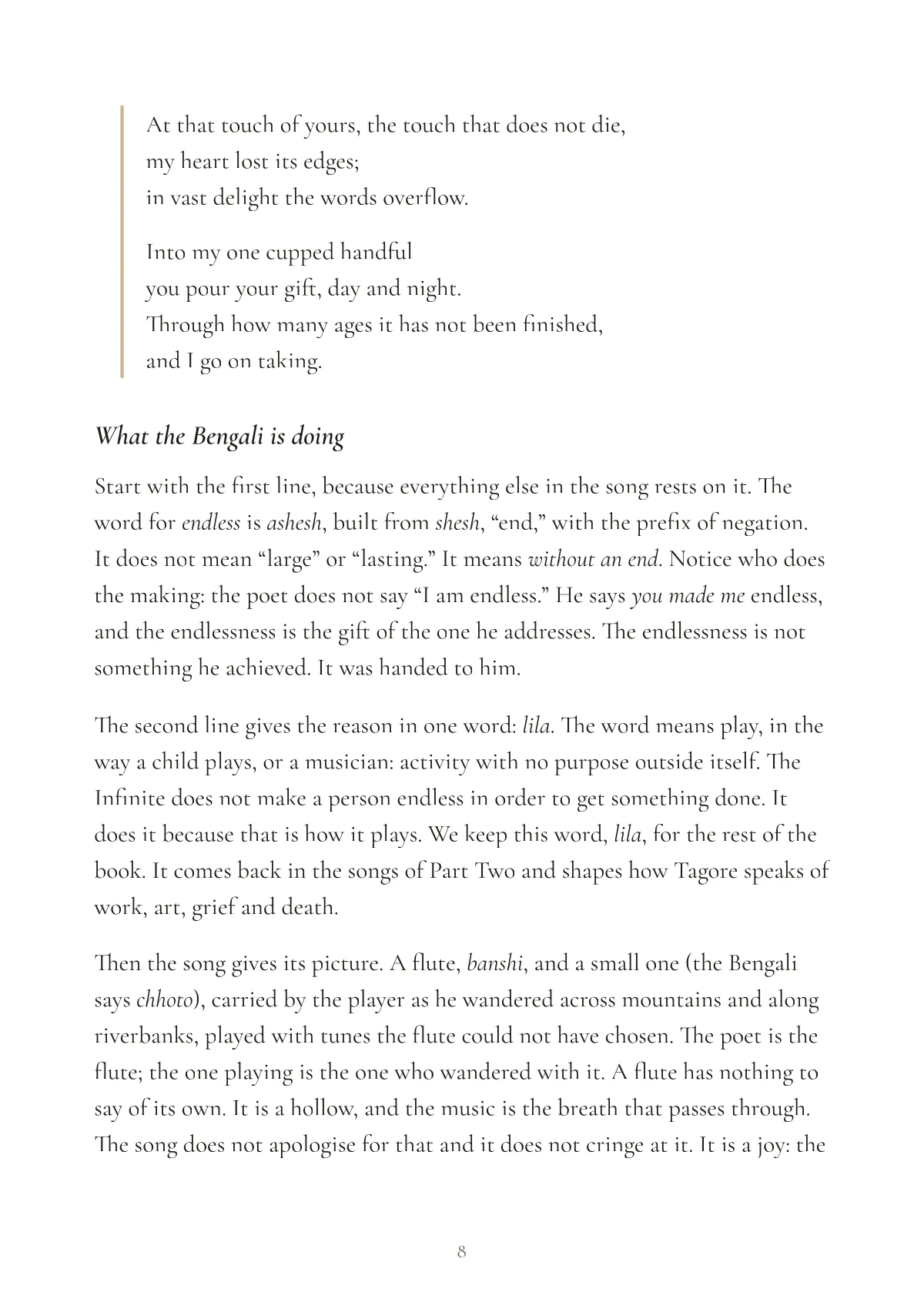
Another Bengali song beside our English translation.
Read the sample pages as text · 5 pages

The words of the 5 pages shown under “Look inside”, from the English edition. Page numbers are the ones printed on the pages.

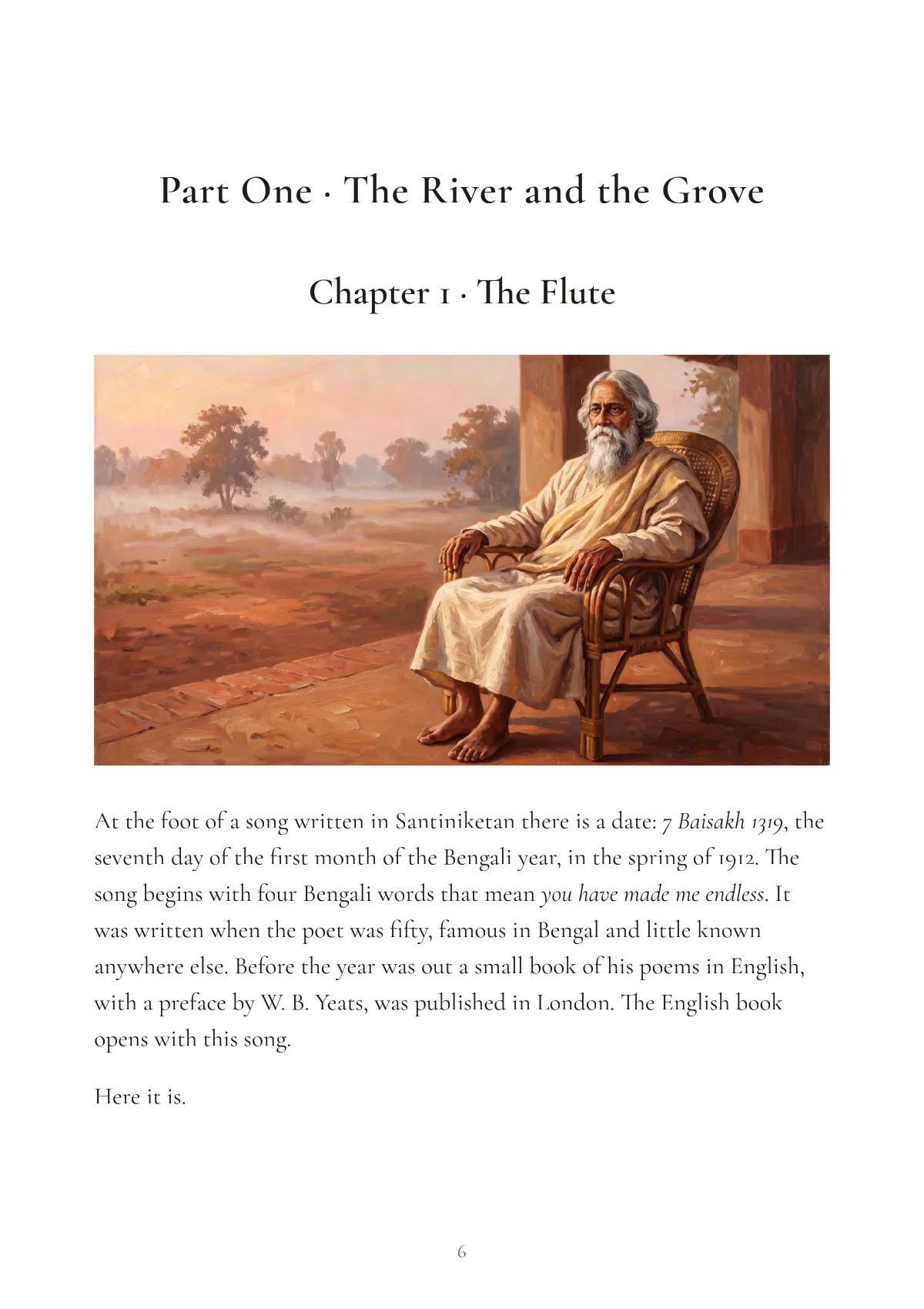
Page 6 · Chapter 1 · The Flute

At the foot of a song written in Santiniketan there is a date: 7 Baisakh 1319, the seventh day of the first month of the Bengali year, in the spring of 1912. The song begins with four Bengali words that mean you have made me endless. It was written when the poet was fifty, famous in Bengal and little known anywhere else. Before the year was out a small book of his poems in English, with a preface by W. B. Yeats, was published in London. The English book opens with this song.

Here it is.

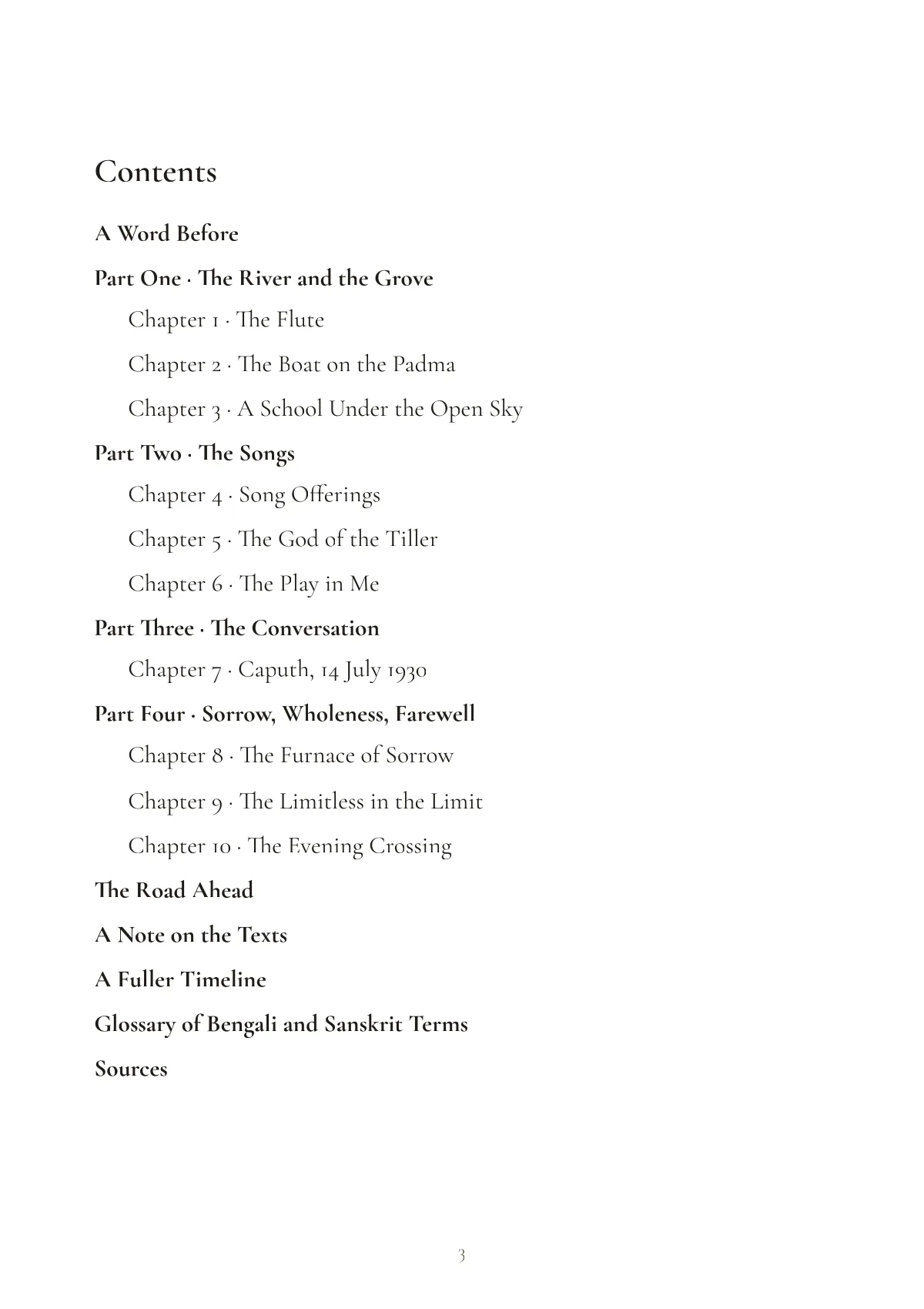
Page 3 · Contents

  • A Word Before
  • Part One · The River and the Grove
  • Chapter 1 · The Flute
  • Chapter 2 · The Boat on the Padma
  • Chapter 3 · A School Under the Open Sky
  • Part Two · The Songs
  • Chapter 4 · Song Offerings
  • Chapter 5 · The God of the Tiller
  • Chapter 6 · The Play in Me
  • Part Three · The Conversation
  • Chapter 7 · Caputh, 14 July 1930
  • Part Four · Sorrow, Wholeness, Farewell
  • Chapter 8 · The Furnace of Sorrow
  • Chapter 9 · The Limitless in the Limit
  • Chapter 10 · The Evening Crossing
  • The Road Ahead
  • A Note on the Texts
  • A Fuller Timeline
  • Glossary of Bengali and Sanskrit Terms
  • Sources

Page 7 · Bengali song and English translation

আমারে তুমি অশেষ করেছ।

এমনি লীলা তব।

ফুরায়ে ফেলে আবার ভরেছ

জীবন নব নব।

কত যে গিরি কত যে নদী-তীরে

বেড়ালে বহি ছোটো এ বাঁশিটিরে,

কত যে তান বাজালে ফিরে ফিরে

কাহারে তাহা কব॥

তোমারি ঐ অমৃতপরশে

আমার হিয়াখানি

হারালো সীমা, বিপুল হরষে

উথলি উঠে বাণী।

আমার শুধু একটি মুঠি ভরি

দিতেছ দান দিবসবিভাবরী,

হল না সারা কত-না যুগ ধরি,

কেবলি আমি লব॥

Gitimalya is the book it comes from, and the number is 23.

Our English:

You have made me endless. Such is your play.

Again and again you empty me, and you fill me again with life made new.

Over how many mountains, along how many riverbanks,

you wandered carrying this small flute,

and how many tunes you have played on it, over and over —

to whom could I ever tell it?

Page 8 · Translation and commentary

At that touch of yours, the touch that does not die,

my heart lost its edges;

in vast delight the words overflow.

Into my one cupped handful

you pour your gift, day and night.

Through how many ages it has not been finished,

and I go on taking.

What the Bengali is doing

Start with the first line, because everything else in the song rests on it. The word for endless is ashesh, built from shesh, “end,” with the prefix of negation. It does not mean “large” or “lasting.” It means without an end. Notice who does the making: the poet does not say “I am endless.” He says you made me endless, and the endlessness is the gift of the one he addresses. The endlessness is not something he achieved. It was handed to him.

The second line gives the reason in one word: lila. The word means play, in the way a child plays, or a musician: activity with no purpose outside itself. The Infinite does not make a person endless in order to get something done. It does it because that is how it plays. We keep this word, lila, for the rest of the book. It comes back in the songs of Part Two and shapes how Tagore speaks of work, art, grief and death.

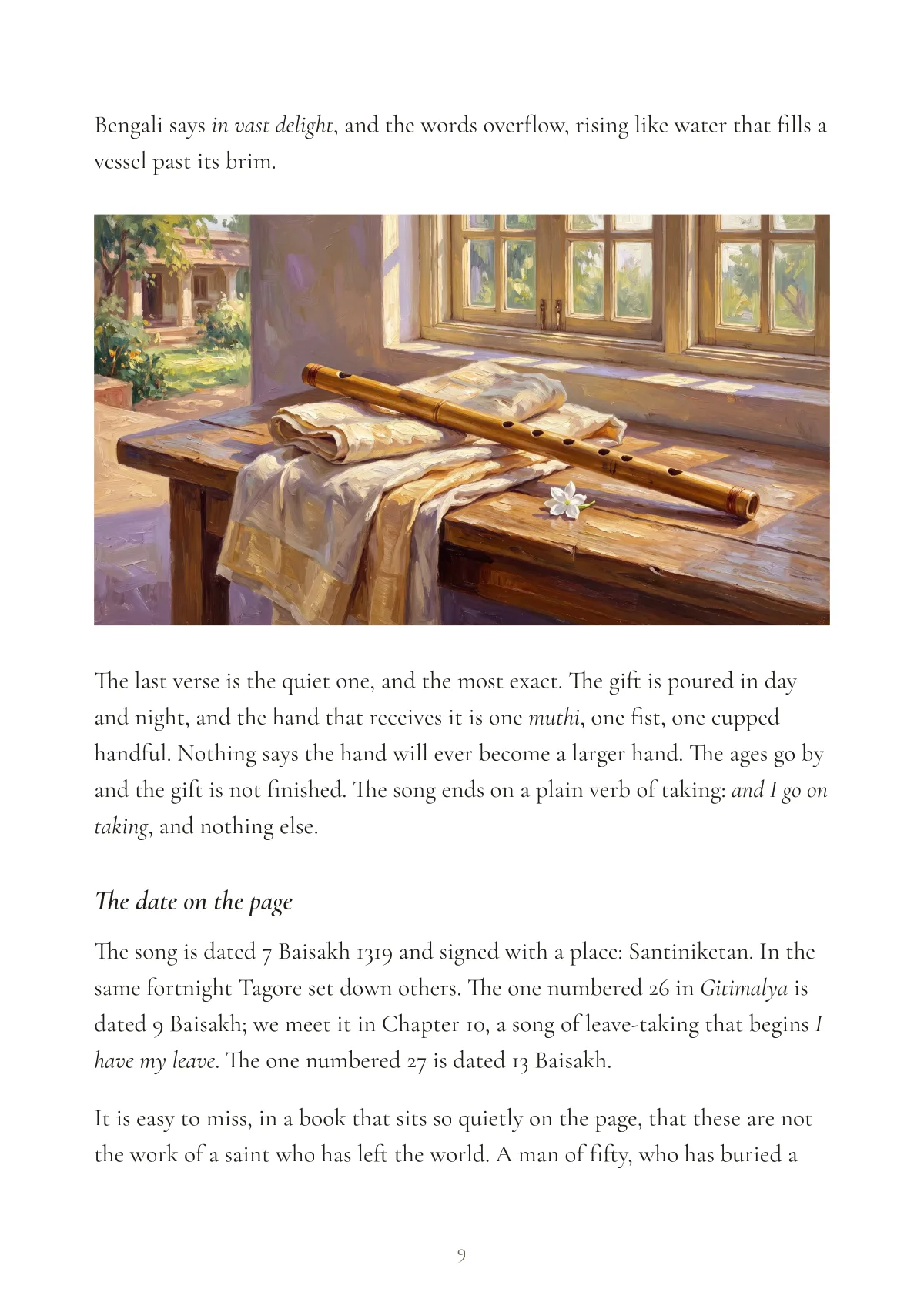
Then the song gives its picture. A flute, banshi, and a small one (the Bengali says chhoto), carried by the player as he wandered across mountains and along riverbanks, played with tunes the flute could not have chosen. The poet is the flute; the one playing is the one who wandered with it. A flute has nothing to say of its own. It is a hollow, and the music is the breath that passes through. The song does not apologise for that and it does not cringe at it. It is a joy: the

Page 9 · Illustration and the story continues

Bengali says in vast delight, and the words overflow, rising like water that fills a vessel past its brim.

The last verse is the quiet one, and the most exact. The gift is poured in day and night, and the hand that receives it is one muthi, one fist, one cupped handful. Nothing says the hand will ever become a larger hand. The ages go by and the gift is not finished. The song ends on a plain verb of taking: and I go on taking, and nothing else.

The date on the page

The song is dated 7 Baisakh 1319 and signed with a place: Santiniketan. In the same fortnight Tagore set down others. The one numbered 26 in Gitimalya is dated 9 Baisakh; we meet it in Chapter 10, a song of leave-taking that begins I have my leave. The one numbered 27 is dated 13 Baisakh.

It is easy to miss, in a book that sits so quietly on the page, that these are not the work of a saint who has left the world. A man of fifty, who has buried a

The Poet of the Inner Temple

Look inside · 5 of 90 pages

Page 3 of the English edition: the contents page, listing four parts, ten chapters and the closing sections.
Contents · page 3
Page 6 of the English edition: the opening of Chapter 1, The Flute, with an illustration of an elderly man with a white beard seated in a cane chair on a veranda in warm light.
Chapter 1 · The Flute · page 6
Page 7 of the English edition: the Bengali song Gitimalya 23 in Bengali script, followed by the first lines of our English translation.
Bengali song and English translation · page 7
Page 8 of the English edition: the end of our English translation of the song and the start of the commentary, What the Bengali is doing.
Translation and commentary · page 8
Page 9 of the English edition: the commentary continues, with an illustration of a wooden flute and a white blossom on a table by a sunlit window.
Illustration and the story continues · page 9

About this pocket edition

A closer look.

Follow Rabindranath Tagore from his boat on the Padma to the school at Santiniketan, through songs and poems from Gitanjali and other Bengali collections, and his conversation with Albert Einstein. This illustrated pocket edition brings his Bengali words close, with our English translations and notes on the life around them.

Read the Bengali songs beside our English translations, then spend time with the words: the flute, the open sky, the work of the tiller, the sorrows of a family and the poems of leave-taking.

The afternoon at Caputh is retold in our own words, with three short passages from the published conversation. A fuller timeline, glossary and named sources give you places to return to as you read.

About this pocket edition

Who this Tagore pocket edition is for.

Accompanying Great Writers and Poets, Rabindranath Tagore: The Poet of the Inner Temple is written for readers drawn to poetry and personal correspondence. Moving from his riverboat on the Padma and Santiniketan to Caputh in 1930 with Albert Einstein, it places Bengali songs beside fresh translations.

What you get

What this pocket edition holds.

Pages
90 illustrated pages
Formats
Reader’s edition with illustrations (PDF & EPUB)
Languages
English, Bengali, Hindi

Contents highlights

What you receive

Both files, right away.

This illustrated pocket edition is available in many languages. Choose yours before you buy: you receive that language's edition as PDF and EPUB.

One purchase gives you the illustrated pocket edition in the language you chose, as both files: the PDF in the printed-page layout, and the EPUB for compatible reading apps and e-readers.

Published and translated by
ClarityOne Publishing. Bengali passages appear in their original script beside our own English translations. The sources and a note on the texts are included.
Formats included
PDF and EPUB, in the language you choose.
Languages available
English · বাংলা · हिन्दी
How delivery works
Right after payment your download page opens with both files. Save them now; they are yours to keep. The page stays open for 30 days at the same address. Stripe emails your receipt.