The words of the 5 pages shown under “Look inside”, from the English edition.
Chapter 1 · A Telegram and a Poem
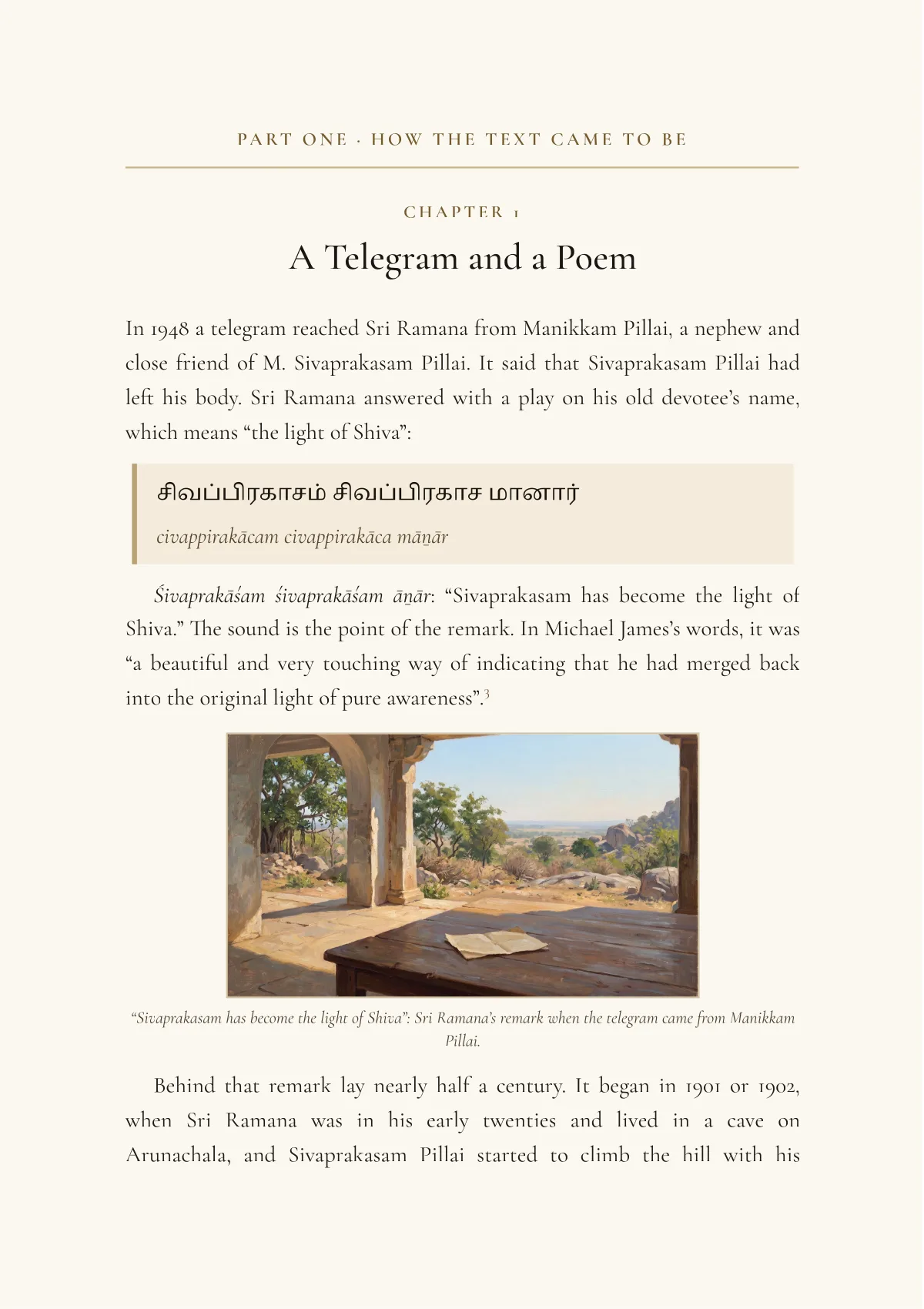
In 1948 a telegram reached Sri Ramana from Manikkam Pillai, a nephew and close friend of M. Sivaprakasam Pillai. It said that Sivaprakasam Pillai had left his body. Sri Ramana answered with a play on his old devotee’s name, which means “the light of Shiva”:
சிவப்பிரகாசம் சிவப்பிரகாச மானார்
civappirakācam civappirakāca māṉār
Śivaprakāśam śivaprakāśam āṉār: “Sivaprakasam has become the light of Shiva.” The sound is the point of the remark. In Michael James’s words, it was “a beautiful and very touching way of indicating that he had merged back into the original light of pure awareness”.
“Sivaprakasam has become the light of Shiva”: Sri Ramana’s remark when the telegram came from Manikkam Pillai.
Behind that remark lay nearly half a century. It began in 1901 or 1902, when Sri Ramana was in his early twenties and lived in a cave on Arunachala, and Sivaprakasam Pillai started to climb the hill with his
A Word Before
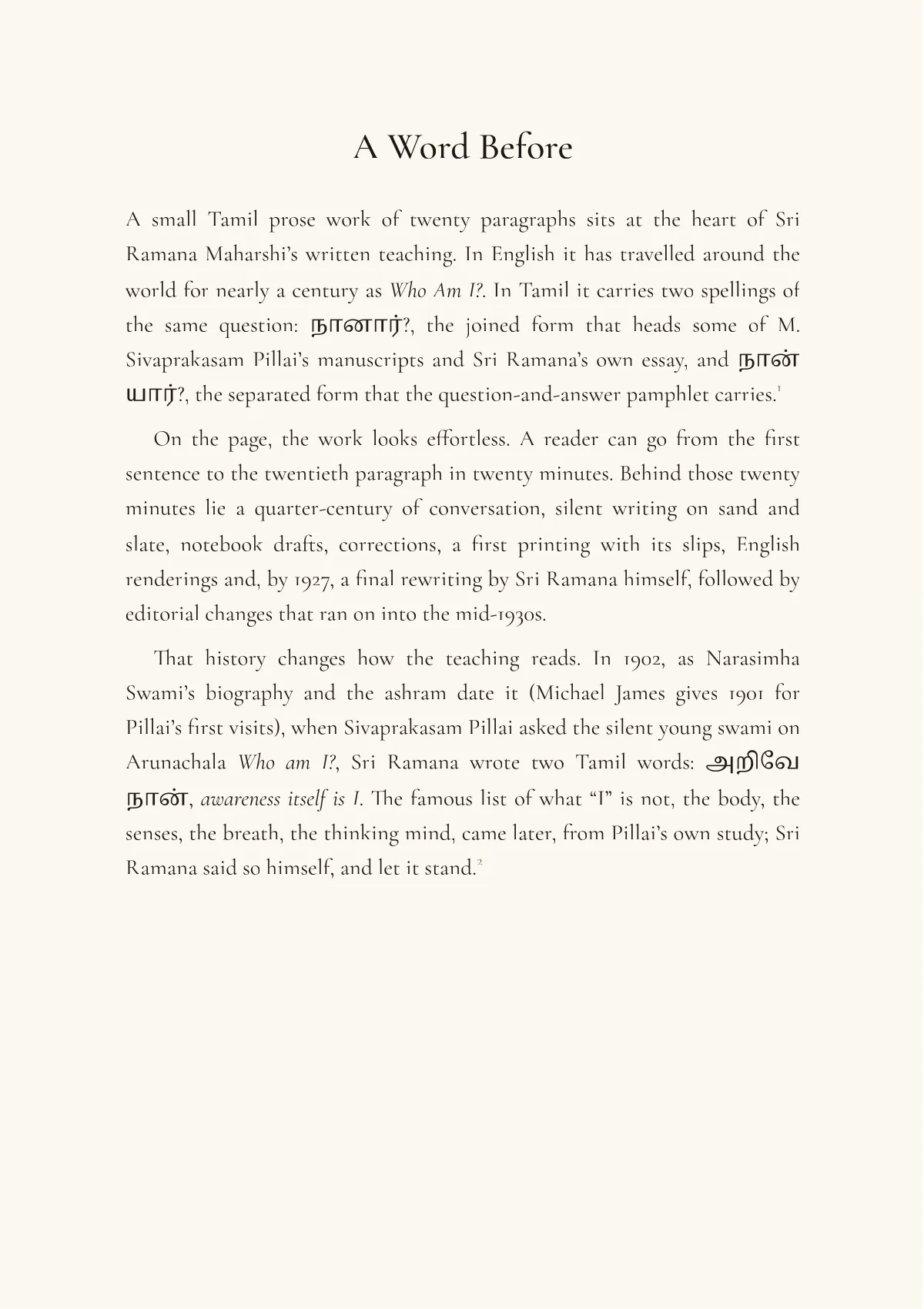
A small Tamil prose work of twenty paragraphs sits at the heart of Sri Ramana Maharshi’s written teaching. In English it has travelled around the world for nearly a century as Who Am I?. In Tamil it carries two spellings of the same question: நானார்?, the joined form that heads some of M. Sivaprakasam Pillai’s manuscripts and Sri Ramana’s own essay, and நான் யார்?, the separated form that the question-and-answer pamphlet carries.
On the page, the work looks effortless. A reader can go from the first sentence to the twentieth paragraph in twenty minutes. Behind those twenty minutes lie a quarter-century of conversation, silent writing on sand and slate, notebook drafts, corrections, a first printing with its slips, English renderings and, by 1927, a final rewriting by Sri Ramana himself, followed by editorial changes that ran on into the mid-1930s.
That history changes how the teaching reads. In 1902, as Narasimha Swami’s biography and the ashram date it (Michael James gives 1901 for Pillai’s first visits), when Sivaprakasam Pillai asked the silent young swami on Arunachala Who am I?, Sri Ramana wrote two Tamil words: அறிவே நான், awareness itself is I. The famous list of what “I” is not, the body, the senses, the breath, the thinking mind, came later, from Pillai’s own study; Sri Ramana said so himself, and let it stand.
A Word Before, continued
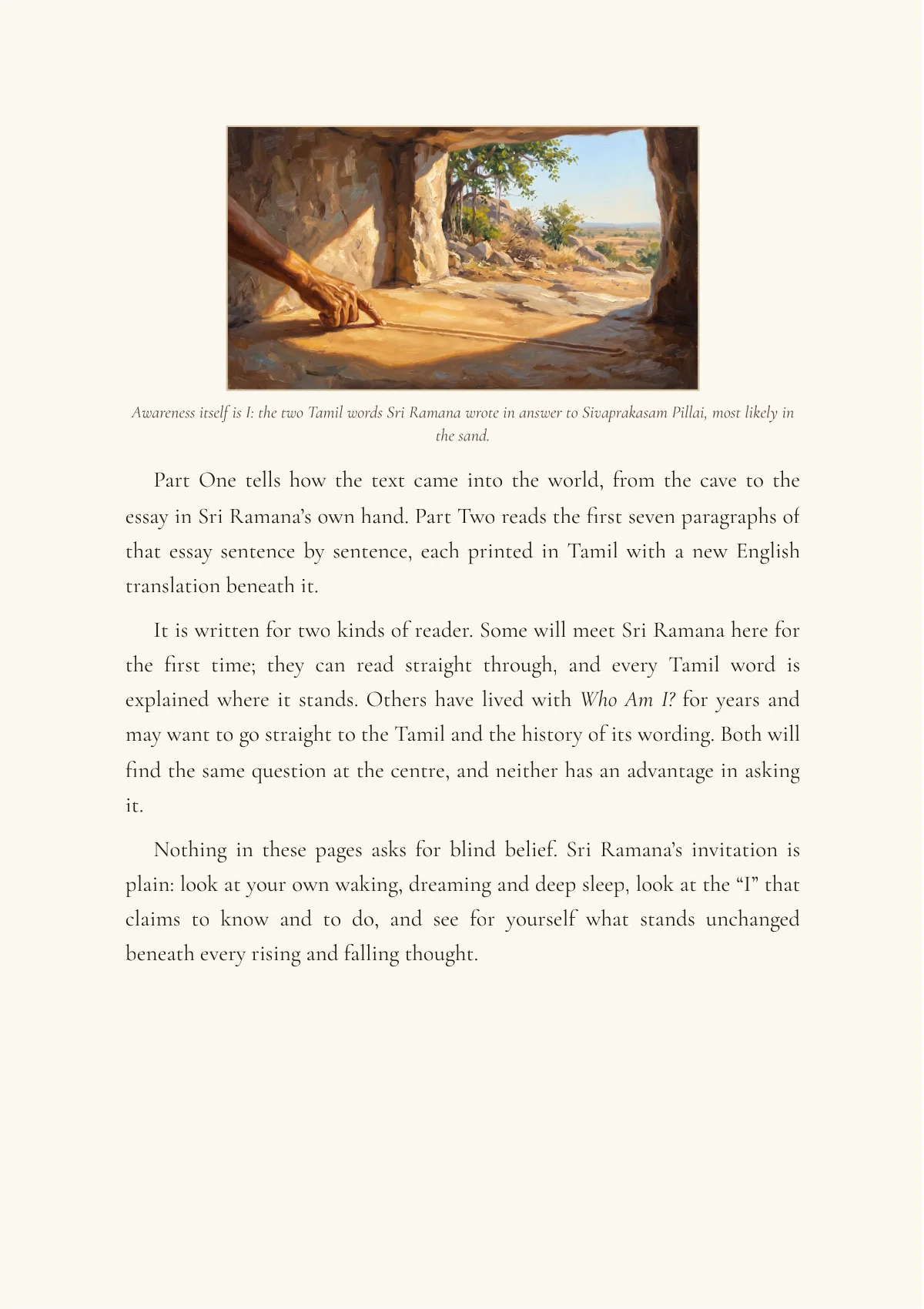
Awareness itself is I: the two Tamil words Sri Ramana wrote in answer to Sivaprakasam Pillai, most likely in the sand.
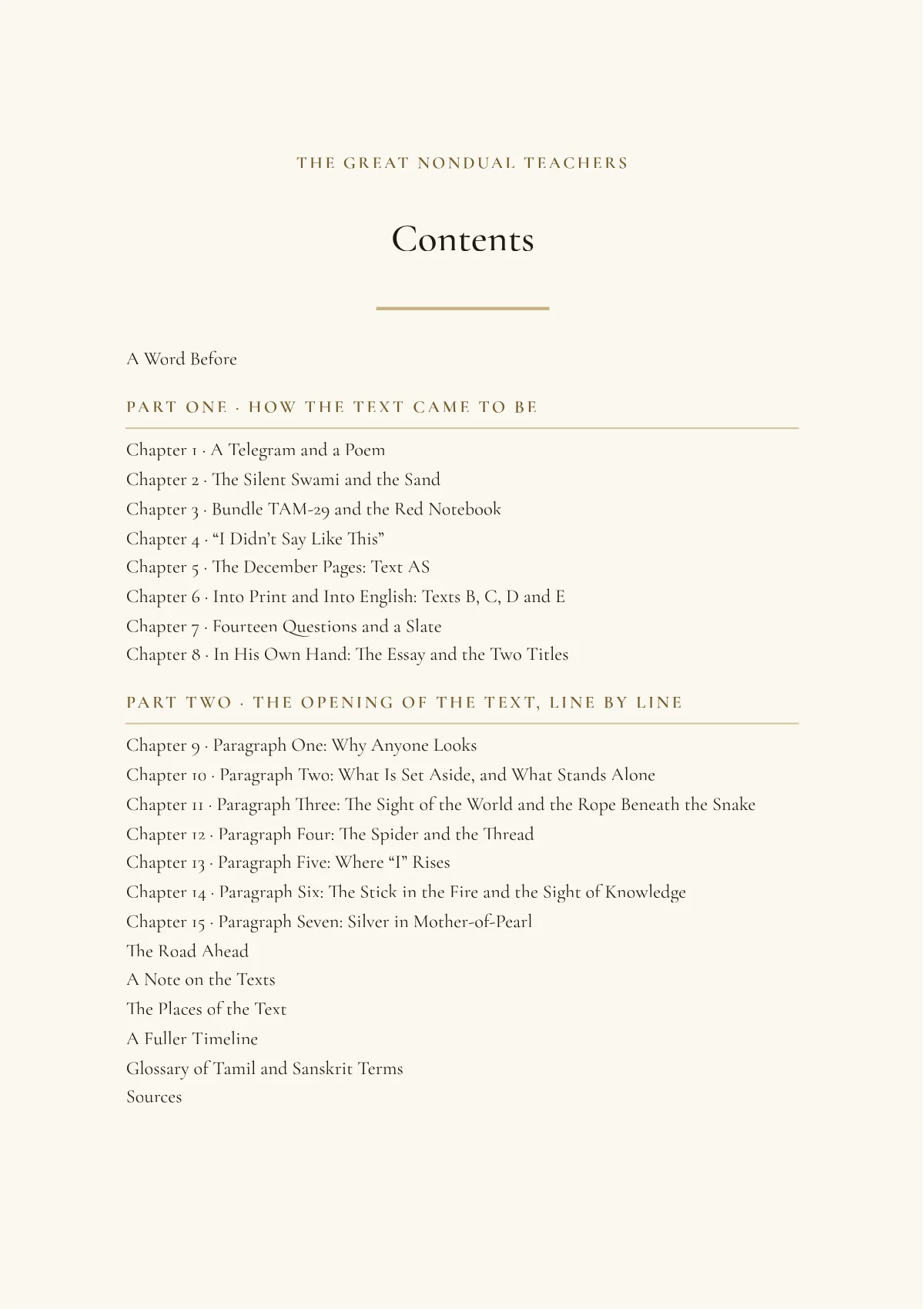
Part One tells how the text came into the world, from the cave to the essay in Sri Ramana’s own hand. Part Two reads the first seven paragraphs of that essay sentence by sentence, each printed in Tamil with a new English translation beneath it.
It is written for two kinds of reader. Some will meet Sri Ramana here for the first time; they can read straight through, and every Tamil word is explained where it stands. Others have lived with Who Am I? for years and may want to go straight to the Tamil and the history of its wording. Both will find the same question at the centre, and neither has an advantage in asking it.
Nothing in these pages asks for blind belief. Sri Ramana’s invitation is plain: look at your own waking, dreaming and deep sleep, look at the “I” that claims to know and to do, and see for yourself what stands unchanged beneath every rising and falling thought.
Chapter 1 · A Telegram and a Poem, continued
questions. More than twenty years would pass before he published any of the answers.
We know what brought him up the hill, because he told it himself. Before 1920 he composed a Tamil poem of 207 lines, Anugraha Ahaval, “The Song of Grace”, which he published in 1923 together with two other poems of his, Śrī Ramaṇa Carita Ahaval and Śrī Ramaṇa Pāda Mālai. The first twenty-four lines praise Sri Ramana. From line 25 Pillai tells his own story.
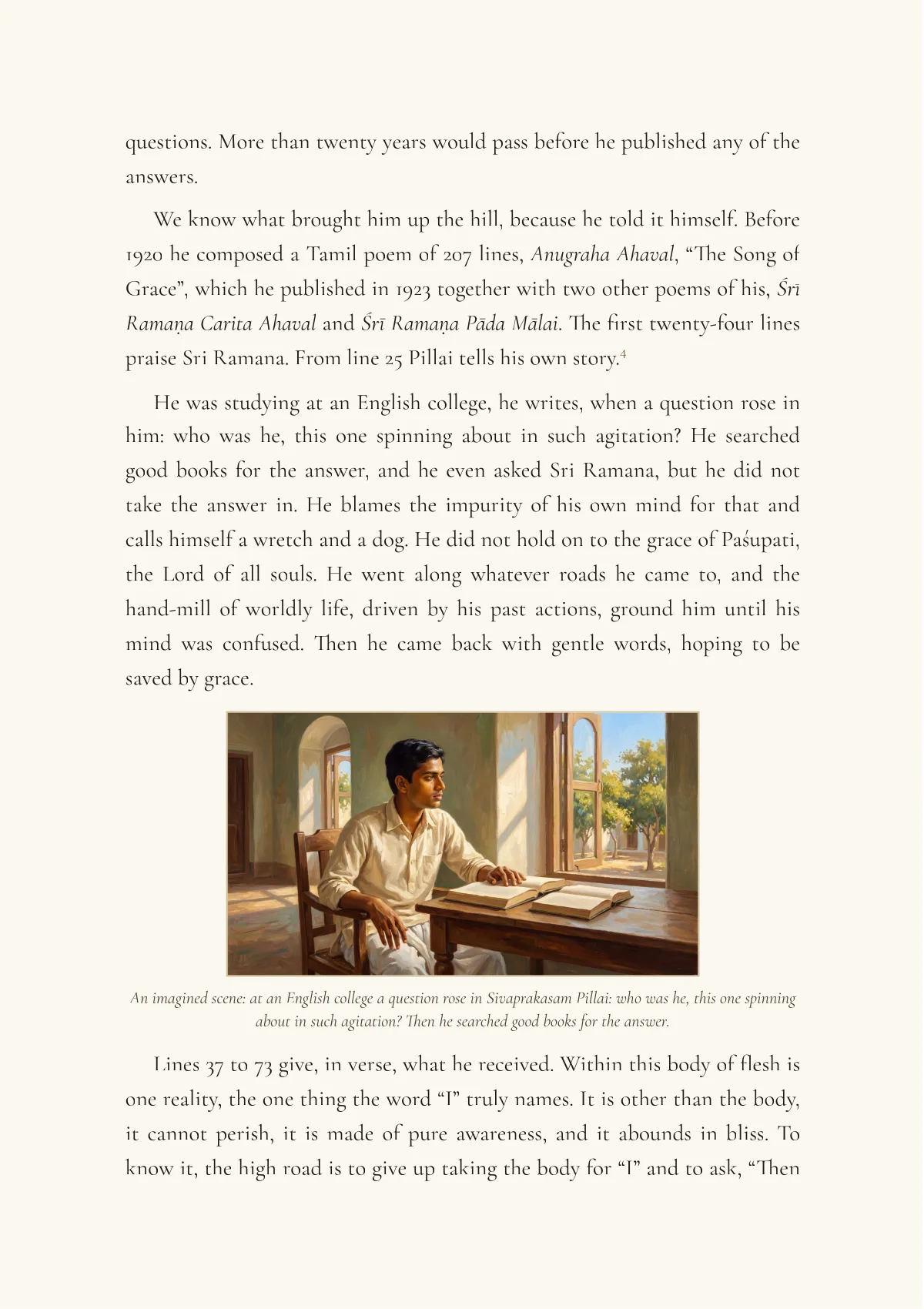
He was studying at an English college, he writes, when a question rose in him: who was he, this one spinning about in such agitation? He searched good books for the answer, and he even asked Sri Ramana, but he did not take the answer in. He blames the impurity of his own mind for that and calls himself a wretch and a dog. He did not hold on to the grace of Paśupati, the Lord of all souls. He went along whatever roads he came to, and the hand-mill of worldly life, driven by his past actions, ground him until his mind was confused. Then he came back with gentle words, hoping to be saved by grace.
An imagined scene: at an English college a question rose in Sivaprakasam Pillai: who was he, this one spinning about in such agitation? Then he searched good books for the answer.
Lines 37 to 73 give, in verse, what he received. Within this body of flesh is one reality, the one thing the word “I” truly names. It is other than the body, it cannot perish, it is made of pure awareness, and it abounds in bliss. To know it, the high road is to give up taking the body for “I” and to ask, “Then