The words of the 5 pages shown under “Look inside”, from the English edition. Page numbers are the ones printed on the pages.
Page 10 · Chapter 1 · Before the First Word
1. Before the First Word: The Brooding Spirit, the Womb of Mercy, and the Living Light
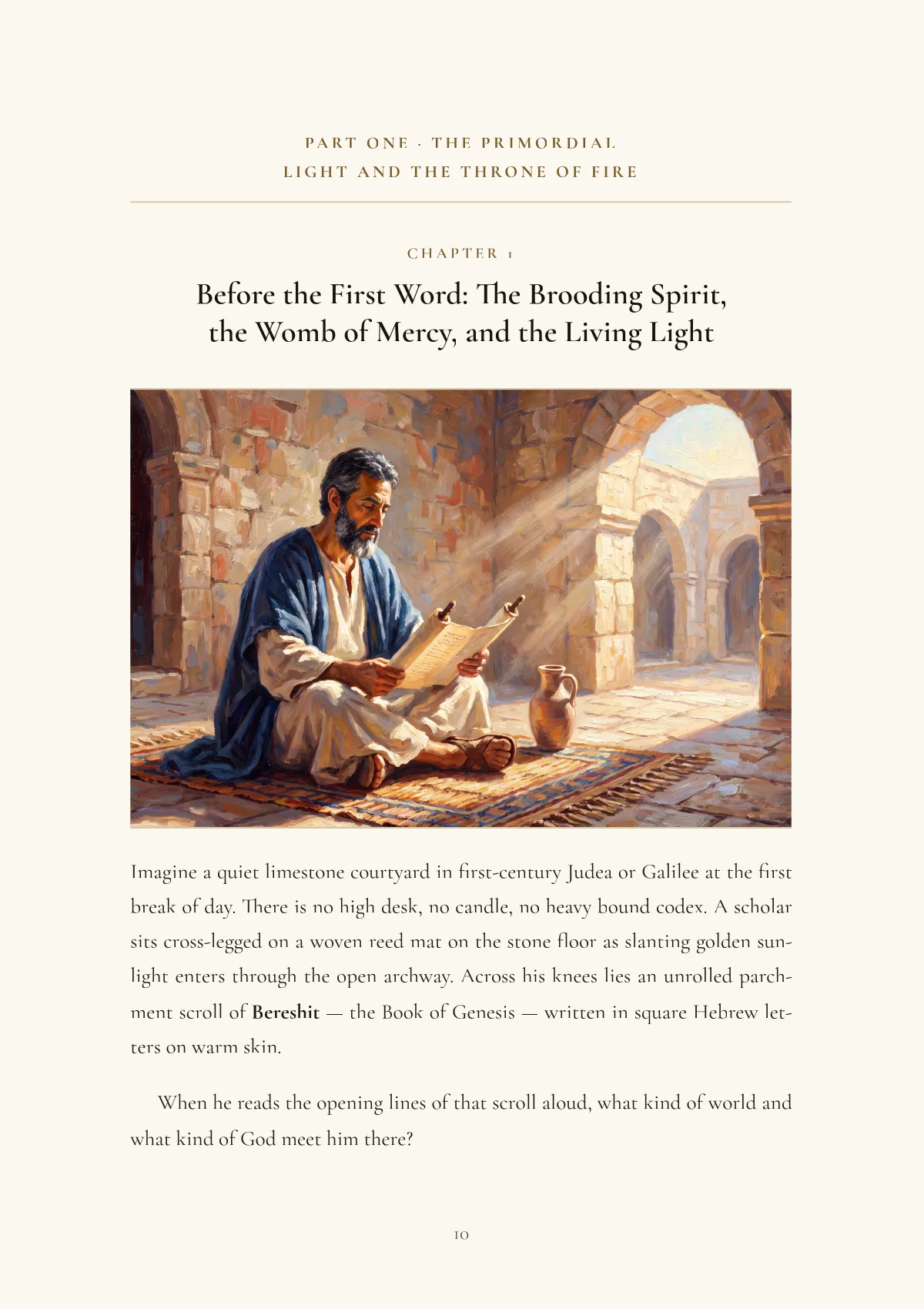
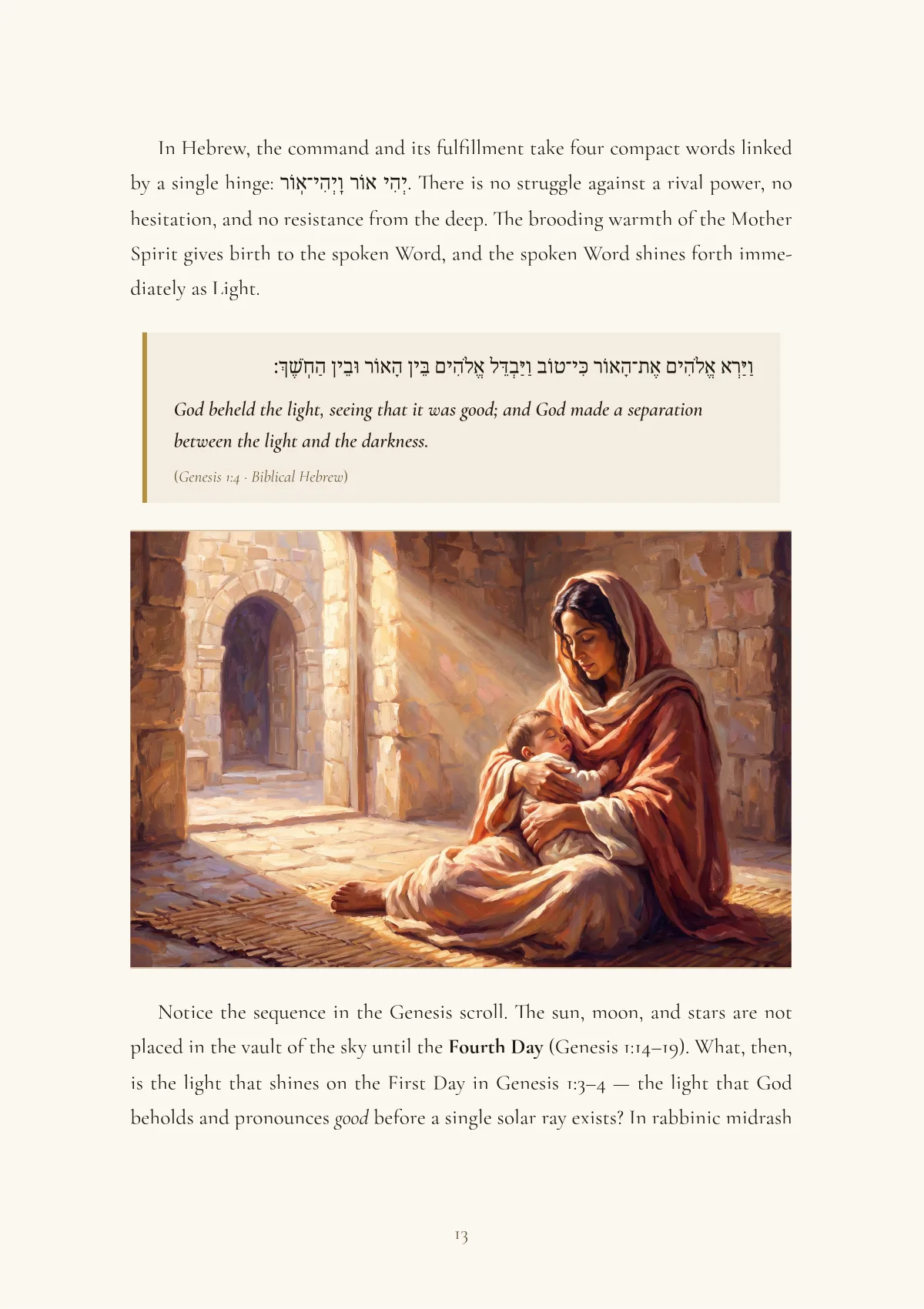
Imagine a quiet limestone courtyard in first-century Judea or Galilee at the first break of day. There is no high desk, no candle, no heavy bound codex. A scholar sits cross-legged on a woven reed mat on the stone floor as slanting golden sunlight enters through the open archway. Across his knees lies an unrolled parchment scroll of Bereshit — the Book of Genesis — written in square Hebrew letters on warm skin.
When he reads the opening lines of that scroll aloud, what kind of world and what kind of God meet him there?
Page 11 · Chapter 1 · Before the First Word, continued
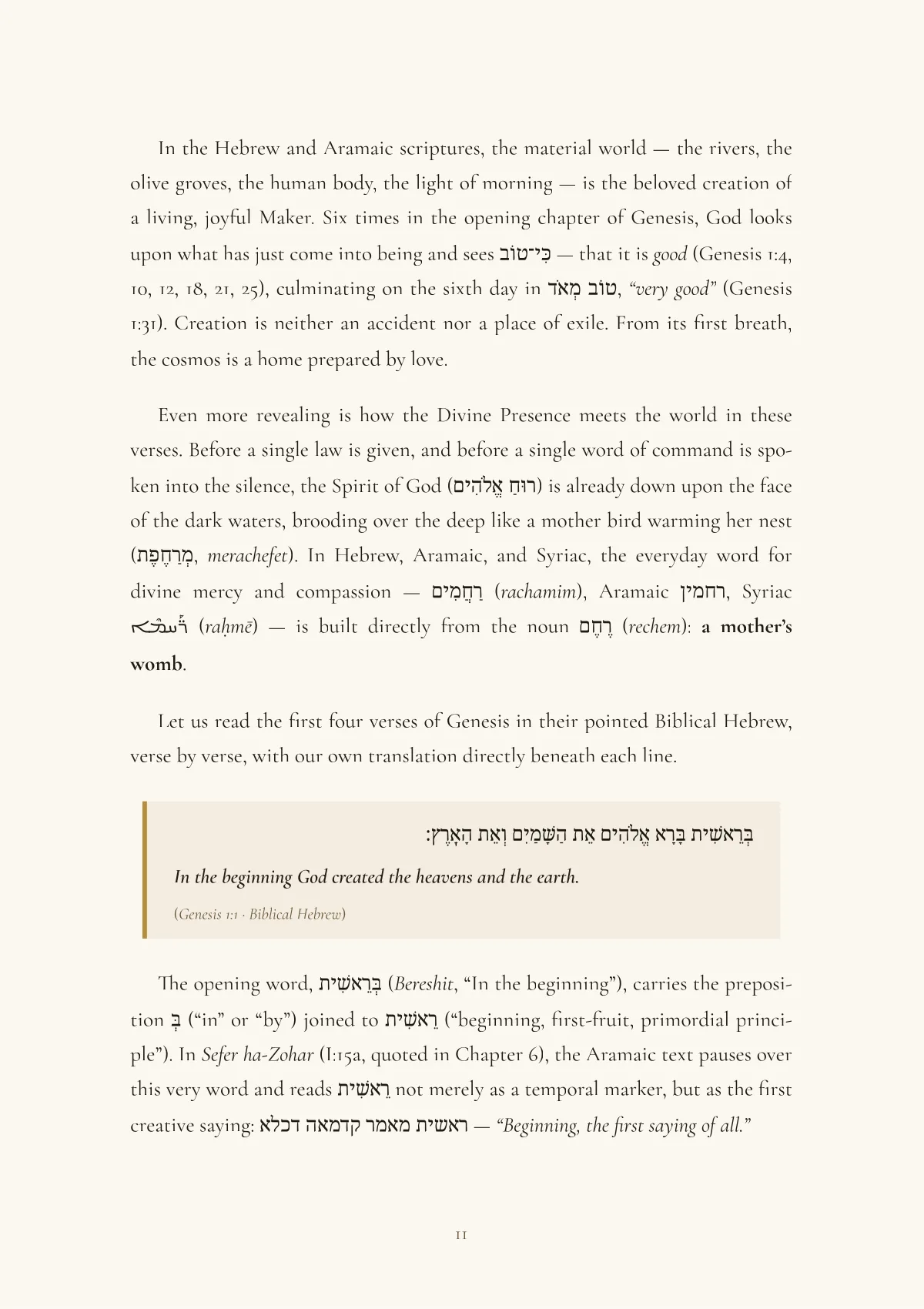
In the Hebrew and Aramaic scriptures, the material world — the rivers, the olive groves, the human body, the light of morning — is the beloved creation of a living, joyful Maker. Six times in the opening chapter of Genesis, God looks upon what has just come into being and sees כִּי־טוֹב — that it is good (Genesis 1:4, 10, 12, 18, 21, 25), culminating on the sixth day in טוֹב מְאֹד, “very good” (Genesis 1:31). Creation is neither an accident nor a place of exile. From its first breath, the cosmos is a home prepared by love.
Even more revealing is how the Divine Presence meets the world in these verses. Before a single law is given, and before a single word of command is spoken into the silence, the Spirit of God (רוּחַ אֱלֹהִים) is already down upon the face of the dark waters, brooding over the deep like a mother bird warming her nest (מְרַחֶפֶת, merachefet). In Hebrew, Aramaic, and Syriac, the everyday word for divine mercy and compassion — רַחֲמִים (rachamim), Aramaic רחמין, Syriac ܪ̈ܰܚܡܶܐ (raḥmē) — is built directly from the noun רֶחֶם (rechem): a mother’s womb.
Let us read the first four verses of Genesis in their pointed Biblical Hebrew, verse by verse, with our own translation directly beneath each line.
בְּרֵאשִׁית בָּרָא אֱלֹהִים אֵת הַשָּׁמַיִם וְאֵת הָאָֽרֶץ׃
In the beginning God created the heavens and the earth.
(Genesis 1:1 · Biblical Hebrew)
The opening word, בְּרֵאשִׁית (Bereshit, “In the beginning”), carries the preposition בְּ (“in” or “by”) joined to רֵאשִׁית (“beginning, first-fruit, primordial principle”). In Sefer ha-Zohar (I:15a, quoted in Chapter 6), the Aramaic text pauses over this very word and reads רֵאשִׁית not merely as a temporal marker, but as the first creative saying: ראשית מאמר קדמאה דכלא — “Beginning, the first saying of all.”
Page 12 · Chapter 1 · Before the First Word, continued
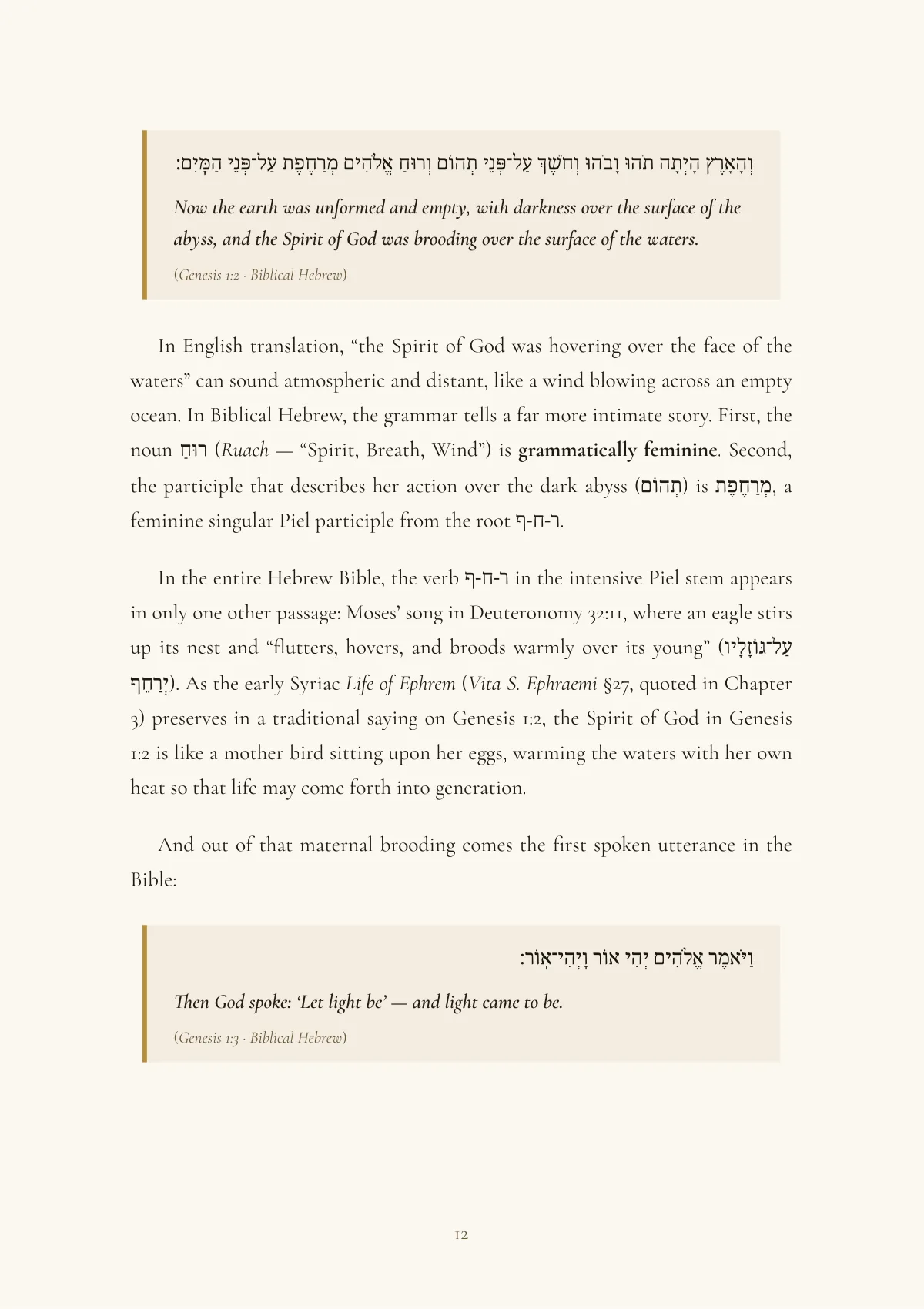
וְהָאָרֶץ הָיְתָה תֹהוּ וָבֹהוּ וְחֹשֶׁךְ עַל־פְּנֵי תְהוֹם וְרוּחַ אֱלֹהִים מְרַחֶפֶת עַל־פְּנֵי הַמָּֽיִם׃
Now the earth was unformed and empty, with darkness over the surface of the abyss, and the Spirit of God was brooding over the surface of the waters.
(Genesis 1:2 · Biblical Hebrew)
In English translation, “the Spirit of God was hovering over the face of the waters” can sound atmospheric and distant, like a wind blowing across an empty ocean. In Biblical Hebrew, the grammar tells a far more intimate story. First, the noun רוּחַ (Ruach — “Spirit, Breath, Wind”) is grammatically feminine. Second, the participle that describes her action over the dark abyss (תְהוֹם) is מְרַחֶפֶת, a feminine singular Piel participle from the root ר-ח-ף.
In the entire Hebrew Bible, the verb ר-ח-ף in the intensive Piel stem appears in only one other passage: Moses’ song in Deuteronomy 32:11, where an eagle stirs up its nest and “flutters, hovers, and broods warmly over its young” (עַל־גּוֹזָלָיו יְרַחֵף). As the early Syriac Life of Ephrem (Vita S. Ephraemi §27, quoted in Chapter 3) preserves in a traditional saying on Genesis 1:2, the Spirit of God in Genesis 1:2 is like a mother bird sitting upon her eggs, warming the waters with her own heat so that life may come forth into generation.
And out of that maternal brooding comes the first spoken utterance in the Bible:
וַיֹּאמֶר אֱלֹהִים יְהִי אוֹר וַֽיְהִי־אֽוֹר׃
Then God spoke: ‘Let light be’ — and light came to be.
(Genesis 1:3 · Biblical Hebrew)
Page 13 · Chapter 1 · Before the First Word, continued
In Hebrew, the command and its fulfillment take four compact words linked by a single hinge: יְהִי אוֹר וַֽיְהִי־אֽוֹר. There is no struggle against a rival power, no hesitation, and no resistance from the deep. The brooding warmth of the Mother Spirit gives birth to the spoken Word, and the spoken Word shines forth immediately as Light.
וַיַּרְא אֱלֹהִים אֶת־הָאוֹר כִּי־טוֹב וַיַּבְדֵּל אֱלֹהִים בֵּין הָאוֹר וּבֵין הַחֹֽשֶׁךְ׃
God beheld the light, seeing that it was good; and God made a separation between the light and the darkness.
(Genesis 1:4 · Biblical Hebrew)
Notice the sequence in the Genesis scroll. The sun, moon, and stars are not placed in the vault of the sky until the Fourth Day (Genesis 1:14–19). What, then, is the light that shines on the First Day in Genesis 1:3–4 — the light that God beholds and pronounces good before a single solar ray exists? In rabbinic midrash