
Evenings Before the Screen, 1965–1988
Companion Notes, Historical Sources & Selected Plates
16 pages
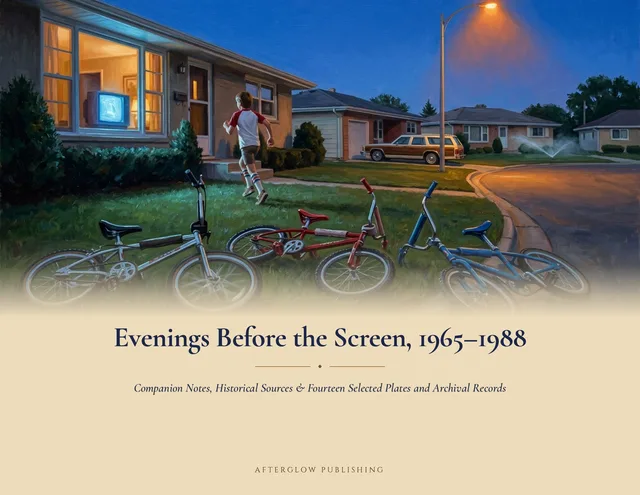
From the booklet
Evenings Before the Screen, 1965–1988
The Screen Was Already in the Room
Before the internet arrived in the kitchen, another screen already organized the evening. By 1960 roughly nine in ten American homes owned a television set; in the Netherlands, registered sets passed one million in October 1961 and two million in April 1965. What differed from our own century was not the presence of a screen, but its boundaries: it stood in one corner of one room, it offered two or three channels, and at a known hour of the night it stopped.
Chapter I: Three Channels and the Midnight Sign-Off
In Britain on Thursday, 2 January 1969, a viewer with a dual-standard receiver had three choices at nine in the evening: BBC-1, BBC-2 and the regional ITV company. In the Netherlands, Nederland 2 had joined Nederland 1 in October 1964; in France, a third public channel arrived only on 31 December 1972.
Getting Up to Turn the Dial
Changing the channel meant leaving your chair, walking across the carpet and turning a heavy mechanical rotary tuner with a firm click through dead frequencies. Even the afternoon had an empty middle: in Britain, routine daytime broadcasting had not yet filled the weekday schedule, and in Dutch homes Wednesday afternoon belonged to children while the rest of the afternoon belonged to the radio, homework or the kitchen table.
Closedown: The Clock, the Anthem and the White Dot
On 2 January 1969, BBC-1 gave its weather forecast at 23:27 and closed down for the night. A mechanical clock face held the screen, the national anthem played, and when the set was switched off at the cabinet the picture collapsed into a single bright white point at the center of the glass and faded into the dark.
Chapter II: The Cinema Queue and the Friday Video Store
Before a film could be carried home in a plastic case, a film was a place you went to on a particular night. When E.T. the Extra-Terrestrial opened in North America on 11 June 1982, or when Star Wars opened in thirty-two American cinemas on 25 May 1977, missing a film in its theatrical run meant waiting years for a network broadcast.