
Was There Really No Room at the Inn?
Luke's Nativity account mentions no innkeeper, no paid roadside inn, and no door shut against Joseph and Mary. One clause explains why Mary laid her newborn son in an animal's feeding trough: "because there was no space for them in the lodging (katalyma)" (Luke 2:7). In Luke's Greek, katalyma differs from his word for a commercial inn and leaves two everyday settings open: a travellers' halting shelter along the road, or the crowded upstairs guest room of a family house.
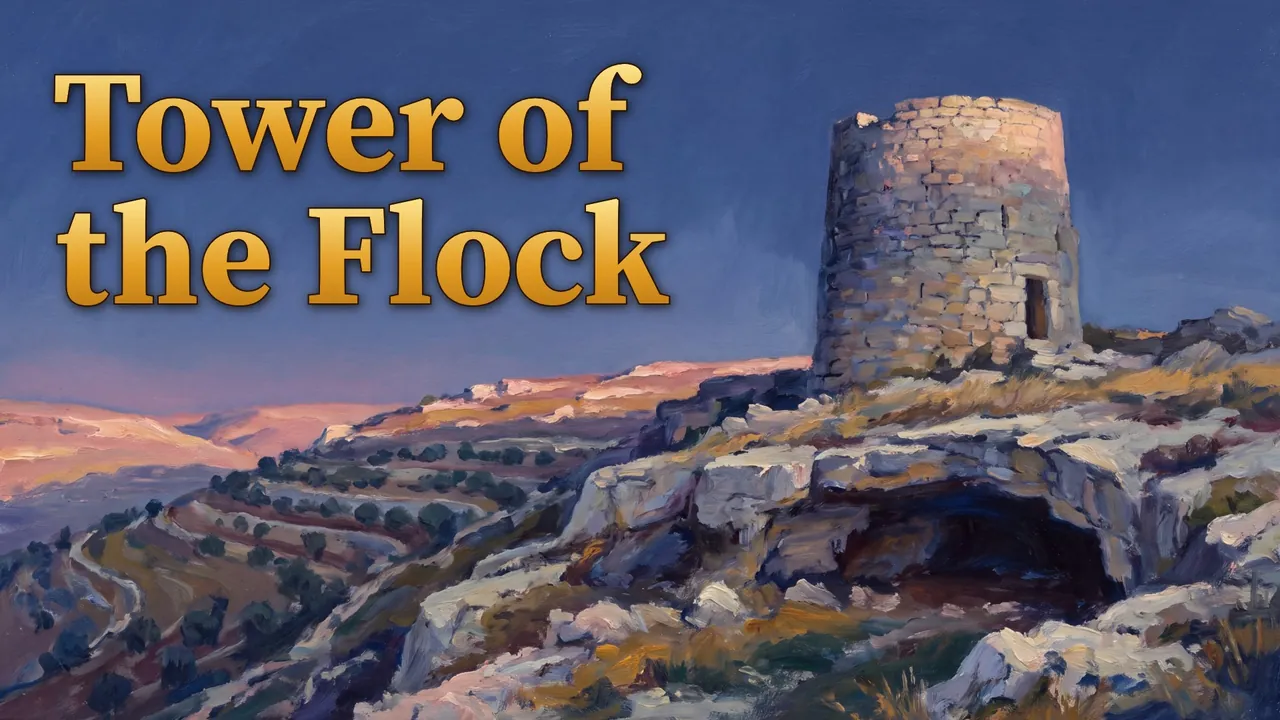
The crowd in Bethlehem starts with Caesar Augustus' decree for "the whole inhabited earth (oikoumenē) to be enrolled in a register", sending people "each to his own town" (Luke 2:1, 3). Joseph travels roughly eighty-five miles south from Nazareth in Galilee to Bethlehem in Judea, "because he was of the house and family line of David", with Mary, "while she was with child" (Luke 2:4–5). Inside that hill town, Luke tells the birth in two spare sentences:
(6) Ἐγένετο δὲ ἐν τῷ εἶναι αὐτοὺς ἐκεῖ, ἐπλήσθησαν αἱ ἡμέραι τοῦ τεκεῖν αὐτήν.
(7) Καὶ ἔτεκε τὸν υἱὸν αὐτῆς τὸν πρωτότοκον, καὶ ἐσπαργάνωσεν αὐτόν, καὶ ἀνέκλινεν αὐτὸν ἐν τῇ φάτνῃ, διότι οὐκ ἦν αὐτοῖς τόπος ἐν τῷ καταλύματι.
Luke 2:6–7 (Greek)
And it came about while they were there that the days were filled for her to give birth. And she gave birth to her son, the firstborn, and bound him in swaddling cloths, and laid him down in a feeding trough (phatnē), because there was no space for them in the lodging (katalyma).
Luke's own Gospel shows how he used katalyma. The noun appears only twice in Luke's Gospel: here in Bethlehem, and in Jerusalem when Jesus sends disciples ahead to prepare the Passover meal:
(10) Ὁ δὲ εἶπεν αὐτοῖς, Ἰδού, εἰσελθόντων ὑμῶν εἰς τὴν πόλιν, συναντήσει ὑμῖν ἄνθρωπος κεράμιον ὕδατος βαστάζων· ἀκολουθήσατε αὐτῷ εἰς τὴν οἰκίαν οὗ εἰσπορεύεται. (11) Καὶ ἐρεῖτε τῷ οἰκοδεσπότῃ τῆς οἰκίας, Λέγει σοι ὁ διδάσκαλος, Ποῦ ἐστι τὸ κατάλυμα, ὅπου τὸ Πάσχα μετὰ τῶν μαθητῶν μου φάγω; (12) Κἀκεῖνος ὑμῖν δείξει ἀνώγεον μέγα ἐστρωμένον· ἐκεῖ ἑτοιμάσατε.
Luke 22:10–12 (Greek)
And he said to them: Look, as you walk into the city, a man carrying an earthen jar of water will meet you; follow him into the house where he enters. And you shall say to the master of the house: The Teacher asks you, "Where is the guest-lodging (to katalyma) where I may eat the Passover with my disciples?" And that man will show you a large upper room spread with cushions; prepare it there.
In Jerusalem, to katalyma is a guest chamber inside a private house, described in the next verse as "a large upper room spread with cushions". When Luke pictured a commercial roadside inn with a host paid in Roman silver coins, in the Good Samaritan parable of Chapter 10, he used another noun altogether: pandocheion, an all-comers' hostelry kept by a pandocheus, an innkeeper.
Even so, Luke 2:7 leaves two possibilities standing. In the Syriac Peshitta, an early Aramaic translation of the Gospel, Middle Eastern households heard the clause as "because there was no space for them where they had halted to stay", from the verb for untying pack-animals at evening. Katalyma in Bethlehem can denote a simple travellers' halting station on the road, or the single upstairs guest room of Joseph's Judean relatives, already full of kin arriving for the registration. Both readings stay open.
Either way, the night needs no villain. Exhaustion and village houses full to the eaves explain why no space remained. In Judean stone village houses built back against limestone rock, guests unrolled mats shoulder to shoulder on the upper family floor, leaving no privacy for a young woman's first labour, while a few stone steps lower beside the rock wall or inside a carved cave-annex behind the house, cattle and donkeys stood beside shallow feeding hollows chipped from bedrock. Mary bound her newborn in swaddling cloths, the clean linen strips ancient midwives used, and laid him in the feeding trough within reach.
Because the katalyma had no space, that feeding trough (phatnē) becomes the night's sign, named three times in sixteen verses. An angel tells shepherds keeping the night watches outdoors: "you will find a baby wrapped in swaddling cloths and lying inside a feeding trough" (Luke 2:12), and hurrying in before dawn they find "the baby lying in the feeding trough" (Luke 2:16).
Neither Luke nor Matthew puts animals in the room, so the ox and donkey make no historical claim; they preserve how third- and fourth-century Christians read Luke's phatnē beside the Greek Septuagint of Isaiah 1:3, where an ox knows its owner and "a donkey the feeding trough (phatnēn) of its lord", and Habakkuk 3:2, "in the midst of two living creatures (en mesō dyo zōōn) You shall be made known". In our own reading, letting go of the invented innkeeper leaves Luke's quiet threshold clearer: crowded rooms move the birth down to the lower stone floor, where working herdsmen in wool cloaks can step straight inside before dawn.
The illustrated pocket edition The Revelation of the Nativity, Book Two: The Cave, the Manger & the Tower of the Flock prints Luke's Nativity and Last Supper passages alongside Isaiah and Habakkuk in Greek, Hebrew and Syriac, with our English beneath each.